
UPDATE: This updated post from 2020 now includes the current status of this facility, and details of the vibration test systems-designed by Team Corporation, as well as links to the new RAL Space virtual tour.
RAL Space is the UK’s national space laboratory, advancing our understanding of space and our environment for the benefit of all. They carry out world-class science, research and technology development with significant involvement in over 210 instruments on missions to date. Explore RAL’s labs and specialist facilities where space missions and projects are brought to life. As the UK’s national space laboratory, RAL Space occupies a unique and independent position between industry, academia and government. The facilities are open to everyone on a commercial basis, whether based in the UK or internationally.
The National Satellite Test Facility will build on and expand the capabilities of the existing RAL Space R100 facility to establish facilities to cover the spectrum of satellites from nanosats / cubesats through to large scale spacecraft and the simultaneous testing of constellations of small satellites. It includes a comprehensive suite of payload and satellite level environmental, physical properties and calibration test facilities – aimed directly at industry’s needs, including the necessary specialist accommodation and equipment.
Large-scale testing capabilities in the National Satellite Test Facility (NSTF) Dynamics Lab
Data Physics and Team Corporation, both members of The NVT Group, have partnered to build the state-of-the-art vibration facility – capable of testing satellites up to 7 tons using two electro-dynamic shakers. Team designed both the horizontal and vertical systems. Team worked closely with Data Physics in incorporating the shakers and supporting equipment into these 2 systems.
These vibration test systems will realistically simulate the mechanical loads experienced during a rocket launch. Two Data Physics LE-5022 Water-Cooled Electrodynamic Shakers, each with 222 kN sine force, 76 mm stroke, and 5 to 2,000 Hz frequency range are used to excite the test subjects. One shaker will operate in the vertical plane (Z axis), while the other will operate horizontally (X and Y axes). A Data Physics 900 Series vibration controller is employed to orchestrate the sometimes extreme vibration forces – while sensitive satellite components will be protected by the controller’s unique Soft Shutdown feature.
Vibration Testing
- ISO8 clean room conditions (with temperature and humidity control)
- Separate vertical and horizontal vibration facilities, both with large guided interface areas to accommodate large and heavy test articles
- Two Data Physics LE-5022 Water-Cooled Electrodynamic Shakers, each with 222 kN sine force, 76 mm stroke 5 to 2,000 Hz frequency range
- Solid state power amplifier with Data Physics proprietary soft shutdown
- Each shaker system includes a Safety Monitor and Control system
- Data Physics 900 Series Controller with 72 channels, including:
- Random Vibration Control
- Sine Vibration Control
- Classical Shock, Transient and SRS Control
- Time Data Recording
Data Analysis Support
- Data Physics 900 Series 512 channel data acquisition system supporting the complete dynamics test suite, including:
- FFT Analysis
- Stepped Sine Analysis
- Sine Data Reduction
- Time Data Recording and Post Processing
- A large stock of accelerometers for rental to test customers
- Data capture also available through high-speed camera and force measuring devices
- Modelling and digital twin capability in development
Data Physics and Team Corporation – NVT Group member companies – have partnered to build this state-of-the-art satellite vibration test facility in the UK. Read the article from 2020 below:
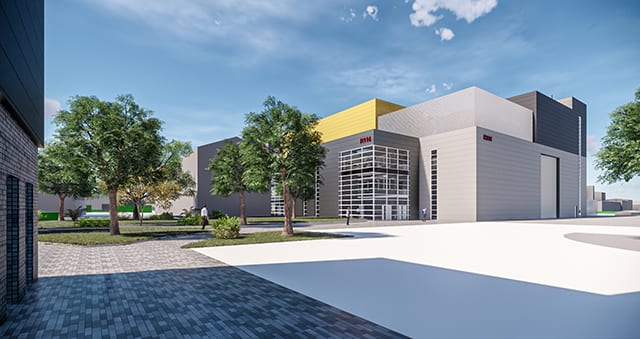
Rendering of National Satellite Test Facility (NSTF)